


What Equipment Can an Occupational Therapist Provide?
What equipment can an occupational therapist provide? From bathing aids to stairlifts, find what keeps you safe and independent at home.
View This BlogSpecial Deal
£11.24Any Courses
Limited Time only


Explore Health and Social Care levels in the UK and learn how each stage boosts your skills, pay, and career development across all care roles. More Inside.
Understanding health and social care levels is the first step toward a successful career in care. In the UK, these levels show how learning progresses and what skills you build. They help people find clear paths into healthcare, social work, and support roles across the country.
The levels in health and social care are UK qualification stages from entry to advanced practice. They show learning depth, responsibility, and competence. Each level builds knowledge and practical skills. It prepares learners for employment, progression, or leadership across care settings and regulated services nationwide, ensuring safe and professional practice.
In this blog, you’ll learn about the main responsibilities, salaries, qualifications, and career routes for each role. By the end of this blog, you’ll have a clear idea of which career suits your skills and how to move forward with confidence.
The levels in health and social care are recognised UK qualification stages showing learning progression and professional development. They explain the knowledge, skills, and responsibilities learners gain as they advance through care roles within sectors. These levels help employers assess competence and support learners in choosing suitable courses aligned with experience and goals.
These levels usually range from Level 1 to Level 5 in the UK. Lower levels introduce basic care principles and safe practice. Levels above this concentrate on leadership skills, decision-making abilities, and management. The qualifications could be in diploma form or through workplace learning, depending on experience and intended fields in health and care services.
Understanding the levels in health and social care supports informed career planning. It helps learners avoid unsuitable courses and wasted time. Knowing each level’s purpose improves confidence when applying for roles or training. It also supports employers by setting clear expectations for skills, responsibility, and progression across care environments in the UK.
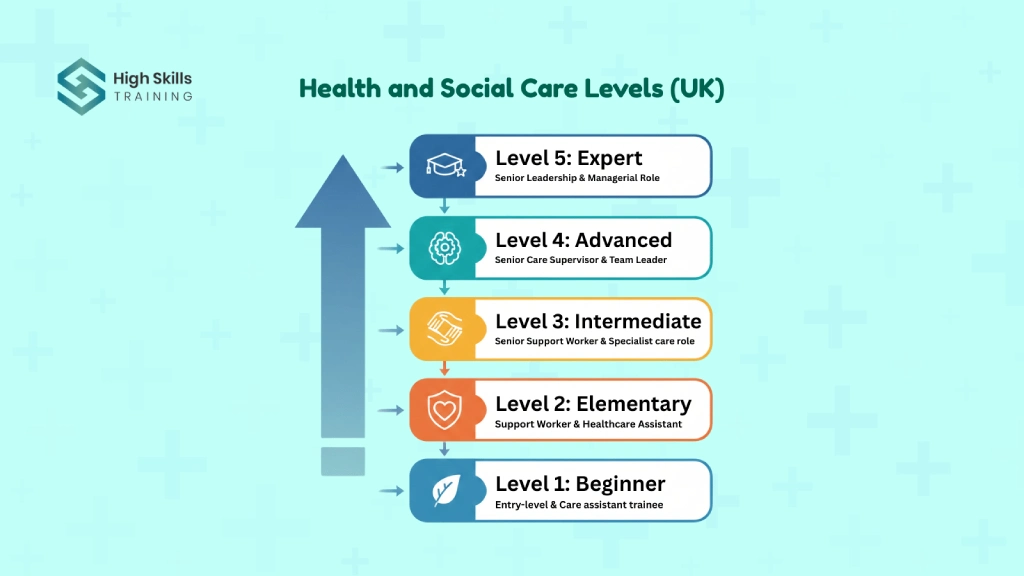
In the UK, health and social care qualifications use a distinct level system. The levels run sequentially from one to another. This helps you progress up each level from one to another, allowing you to increase your knowledge and confidence as you go through each one.
Whether you are new to the care industry or wish to move into a more senior role, these levels will help you grasp which route is right for you. Each level will also move you through some very useful skills that you will be able to utilise.
If you are new to the health and social care industry and wish to get to know the industry, Level 1 certification is the place to start. It will help you understand the basics of the industry by working in the care sector. No prior knowledge is necessary.
Level 1 focuses on building general awareness. You learn the basics of care settings, as well as what care settings and individuals in the field of care expect from you. This helps you make an informed decision regarding whether to pursue a career in care.
Which roles can you join with Level 1:
Level 2 is suitable for you if you have basic care knowledge or work in a caregiving environment. The programme is designed for students who wish to develop practical skills while taking on greater responsibilities to assist others in daily care work.
The programme teaches students how to perform actual care work. Students will acquire skills to handle patient safety issues while they learn to implement care plans and develop professional communication skills. The programme helps you build confidence to work with others while it prepares you for healthcare and social work tasks.
Which roles can you join with Level 2:
The Level 3 programme suits workers who already provide care services and those who want to become skilled professionals. The programme helps students who need to learn more about their field of study while delivering care to individuals who have different needs.
The programme helps you build better decision-making abilities while you learn to handle complicated care requirements. This programme teaches you independent work skills, wellbeing support methods, and professional standard maintenance for various care environments.
Which roles can you join with Level 3:

Level 4 programme for experienced caregivers seeking to become supervisors or specialists in their field. The training programme develops leadership skills, teaches proper care delivery methods, and builds team support skills for health and social care professionals.
This level helps you develop confidence in decision-making and supervision. You learn how to manage care practices, support staff development, and ensure services meet required standards and expectations.
Which roles can you join with Level 4:
The Level 5 programme serves professionals who hold executive or managerial roles. This programme trains students to become service leaders who manage teams and maintain quality standards for their organisations.
This level focuses on strategic thinking and leadership. You learn to handle resources while developing care services, fulfilling regulatory needs, and helping staff and individuals in care.
Which roles can you join with Level 5:

The salary structure of the UK is different at each Health & Social Care level. As you go through the levels, you can achieve better pay by adding to your skills. Employers are more likely to offer higher pay and senior roles, so your career can grow steadily over time.
Moreover, your salary also depends on your experience, location, and the organisation you work for. Private care providers often offer higher pay, while the National Health Service (NHS) roles usually provide stronger job security and good benefits. You can achieve more earning potential through level completion.
Here are the average salary ranges in the UK at each level:
| Level | Typical Roles | UK Salary Range (Per Year) |
| Level 1 | Trainee | £18,000 – £22,000 |
| Support Assistant | ||
| Level 2 | Care Assistant | £20,000 – £25,000 |
| Support Worker | ||
| Level 3 | Senior Support Worker | £24,000 – £30,000 |
| Supervisor | ||
| Level 4 | Team Leader | £28,000 – £38,000 |
| Deputy Manager | ||
| Level 5 | Care Manager | £40,000 – £70,000+ |
| Service Lead |

One of the best things about working in health and social care is the clear path for growth. With the right qualifications, you can start in an entry-level role and gradually move into more senior positions. Every step you take builds skills, confidence, and responsibility for your professional growth.
In addition to this, progressing through the different levels also helps to demonstrate your commitment and reliability to employers. This helps create better job opportunities with more money and more enjoyable work.
Moreover, if you want to move on from working directly with people to a higher management position, the level system helps you to do this as well.
Let’s take a look at the career progression:
| Level | Typical Roles | UK Salary Range (Per Year) |
| Level 1 | Trainee | £18,000 – £22,000 |
| Support Assistant | ||
| Level 2 | Care Assistant | £20,000 – £25,000 |
| Support Worker | ||
| Level 3 | Senior Support Worker | £24,000 – £30,000 |
| Supervisor | ||
| Level 4 | Team Leader | £28,000 – £38,000 |
| Deputy Manager | ||
| Level 5 | Care Manager | £40,000 – £70,000+ |
| Service Lead |
Choosing the right level depends on your current experience and what you want to achieve. If you’re new to care, Level 1 is the best starting point because it builds basic knowledge, confidence, and a good understanding of the sector.
Once you’ve gained some experience, Level 2 is a great next step. It helps you work as a care assistant or support worker, developing practical skills for daily care tasks and making you job-ready. Many people use this level to start working in care.
After that, Level 3 is ideal if you want to move into senior or supervisory roles. Levels 4 and 5 suit those aiming for leadership or management positions, with a focus on advanced skills and service delivery.
Pro Tip: No matter which level you choose, every step brings you closer to a rewarding and secure career in health and social care.
Moving up in health and social care gives your skills and confidence for your career progression. Progression usually involves completing your current qualification, gaining experience in a care setting, and choosing the right next level. With planning and support, advancing your career becomes clear and achievable.
Taking time to review your goals can make progress easier. Some learners move on through further study, while others progress through workplace training. Guidance from tutors, employers, or training providers can help you choose the right path and prepare for increased responsibility.
Follow these steps to level up:

Only for £59 (was £999)
Access 400+ expert-led courses for 12 months.No hidden fees. Cancel anytime.
Get Access NowLevel 2 Health and Social Care alone is usually not enough for university entry. Most universities require Level 3 qualifications. However, Level 2 is a useful stepping stone that helps you progress to Level 3 and build the experience needed for higher study.
Yes, you may be able to start NVQ Level 3 without Level 2 if you have relevant work experience in a care setting. Many training providers accept practical experience as an alternative, especially if you are already working and can show suitable skills and responsibilities.
Level 5 Health and Social Care is suitable for experienced care professionals, usually those in senior, supervisory, or management roles. Learners often need a Level 3 or Level 4 qualification and relevant work experience, as the course focuses on leadership and service management.
With a Level 3 Health and Social Care qualification, you can apply for degrees such as nursing, social work, public health, health studies, psychology, or healthcare management. Entry requirements vary, so universities may also consider grades, UCAS points, and work experience.
A Health and Social Care qualification can support your journey into nursing, but it does not qualify you as a nurse on its own. You must complete an approved nursing degree and meet Nursing and Midwifery Council (NMC) requirements to become a registered nurse in the UK.
Health and Social Care levels give you a clear route into the care sector, no matter your starting point. Level 1 is great if you’re just getting started, while the higher levels help you move into more skilled and rewarding roles over time.
As you progress, you build real experience and confidence, and employers notice. The more you learn and develop, the more opportunities you’ll have to take on better roles and earn more. It’s a practical way to grow your career step by step.
Knowing the different levels of health and social care makes it easier to plan your future. Whether you want to stay hands-on or move into leadership, these levels help you choose the right path and keep moving forward.

High Skills Training is a UK-based CPD training provider offering structured online courses and educational resources across health and social care, business administration, and professional development, supporting recognised standards and ongoing workforce development.
Get the latest insights, tutorials, and deep dives delivered to your inbox every week.
🔒 No spam. Unsubscribe anytime.
What equipment can an occupational therapist provide? From bathing aids to stairlifts, find what keeps you safe and independent at home.
View This Blog
Occupational therapy benefits explained: how it rebuilds independence, mobility and confidence for adults and children across the UK
View This Blog
Explore occupational therapy vs physiotherapy and learn key differences, shared goals, and career guidance for UK care professionals and aspiring therapists.
View This Blog
