



How to Get Pet First Aid Certified in the UK?
Learn how to get pet first aid certified in the UK. Find accredited courses, understand certification types, and discover why it matters for pet...
View This BlogSpecial Deal
£11.24Any Courses
Limited Time only


A body collapses, and suddenly silence replaces breath. Panic fills the air, yet your hands begin CPR, fighting to pull a life back from the edge. Each compression becomes a plea for another heartbeat, another chance, another tomorrow. But in the middle of that desperate hope, a haunting question rises within you: “Should you keep going… or is it time …
A body collapses, and suddenly silence replaces breath. Panic fills the air, yet your hands begin CPR, fighting to pull a life back from the edge. Each compression becomes a plea for another heartbeat, another chance, another tomorrow.
But in the middle of that desperate hope, a haunting question rises within you: “Should you keep going… or is it time to stop? When should you stop CPR? It means not giving up hope, but when life has come back to the body, breathing or movements, and hope to replace the silence, the CPR should be stopped.
In this blog, you will learn about what CPR is, the importance of CPR, when to start CPR, how to perform CPR, when to stop CPR, and more. Let’s explore this more deeply:
CPR, or Cardiopulmonary Resuscitation, is a life-saving emergency procedure performed when a person’s heart stops beating or breathing stops. It is a temporary life support system that helps maintain blood circulation and oxygen delivery in the body until medical experts arrive.
It primarily consists of chest compressions, which also pump blood to the brain and other vital organs. Training individuals to perform rescue breaths can also help supply oxygen, but in most cases, hands-only CPR is very effective.
Considering all factors, CPR has the potential to give an individual a high chance of survival during sudden cardiac arrest. Immediate application of CPR has a broad impact, particularly in the first few minutes, which are crucial.

CPR is important from many perspectives. The importance of CPR can’t be described in only words. From all of those perspectives, here are some of the key points I describe below-
CPR helps to push blood into the body when the heart stops working. If blood circulation is normal in the normal stage, the chance of survival will increase.
When someone provides CPR, it helps the movement of oxygen in the brain and body. Then it will activate the brain.
If CPR starts early, it helps maintain normal blood circulation, keeps the brain active, and it will increases a person’s chance of living.
It helps to provide life support until medical help arrives. We can also say that it is the primary treatment for cardiac arrest and many issues.
CPR is useful in heart attacks, drowning, electric shock, and more. It helps sustain the body’s vital functions and makes the person feel better.
The knowledge of CPR helps people to stay calm in any emergency. By staying calm, he may help to improve the condition of the cardiac arrest patient.
In any emergency in a society, someone who has knowledge of CPR may help in a life-saving situation.
If you know about the CPR process and practices, you will become a lifesaver from an ordinary person in any emergency. Learning CPR builds your confidence level higher in life-saving situations, reduces panic during emergencies, and strengthens you to take action when others don’t.
It’s a small knowledge but has a huge impact, which makes you a ready, polished, and responsible community member. In short, learning CPR means being ready to save a life when it matters the most.
People have a wrong perception about CPR by believing that it is only applicable to healthcare workers. Anyone can learn it. It is simple, convenient and may be executed either at home or at the workplace, on the street or even in sports activities. The majority of cardiac arrests occur in the presence of relatives, and therefore, learning CPR techniques would save a life.
In CPR, ABC is a very effective way to maintain the safety steps you should follow when someone’s heart or breathing is stopped. It provides a step-by-step guideline to a rescuer to stay focused and confident during an emergency. Let’s see what ABC means in CPR:
The first step is A, which means Airway, which ensures that the patient’s airway is open and clear. You should tilt the person’s head back and raise the chin to prevent the tongue from blocking the throat. Oxygen cannot reach the lungs without clear air movement, even if you give breaths to the person.
The second step is B, which means Breathing. You should check some body parts to see if the person is breathing normally. You should look at the chest, listen for airflow, and feel for breaths. But this shouldn’t take more than 10 seconds. If the patient is not breathing or only gasping, you should provide rescue breaths, typically after every 30 chest compressions provided.
The final step is C, which means Compressions; you should press the chest of the patient. Compressions are the most important part of CPR. Push hard and fast in the centre of the chest to keep blood circulating to the vital organs of the body. The objective will remain for a rate of 100–120 compressions per minute and allow the chest to fully rise between pushes.

There remain three types of CPR based on the different ages of a person. Those are Adult CPR, Children’s CPR, and Infant CPR.
In adult CPR, strong and deep compressions are needed because adults have bigger chests and stronger ribs.
You should give full, strong rescue breaths to adults because their lungs need more air.
Child CPR is almost similar to adult CPR, but it requires less force due to their smaller body size.
Rescue breathing for children should be flexible and enough to make the chest rise.
Infant CPR requires sensitive or careful handling and controlled compressions because their bodies are extremely small and fragile.

Infants require very small, careful breaths because their lungs are tiny.
If you confirm that a person is not responding and not breathing normally, you should start CPR as soon as possible. This situation usually happens in emergencies such as cardiac arrest, drowning, choking, or sudden collapse.
High time to start CPR-
In this situation, you should not wait for medical help to arrive. Every second counts, and starting CPR immediately can keep the patient’s brain and heart alive until the experts take over.
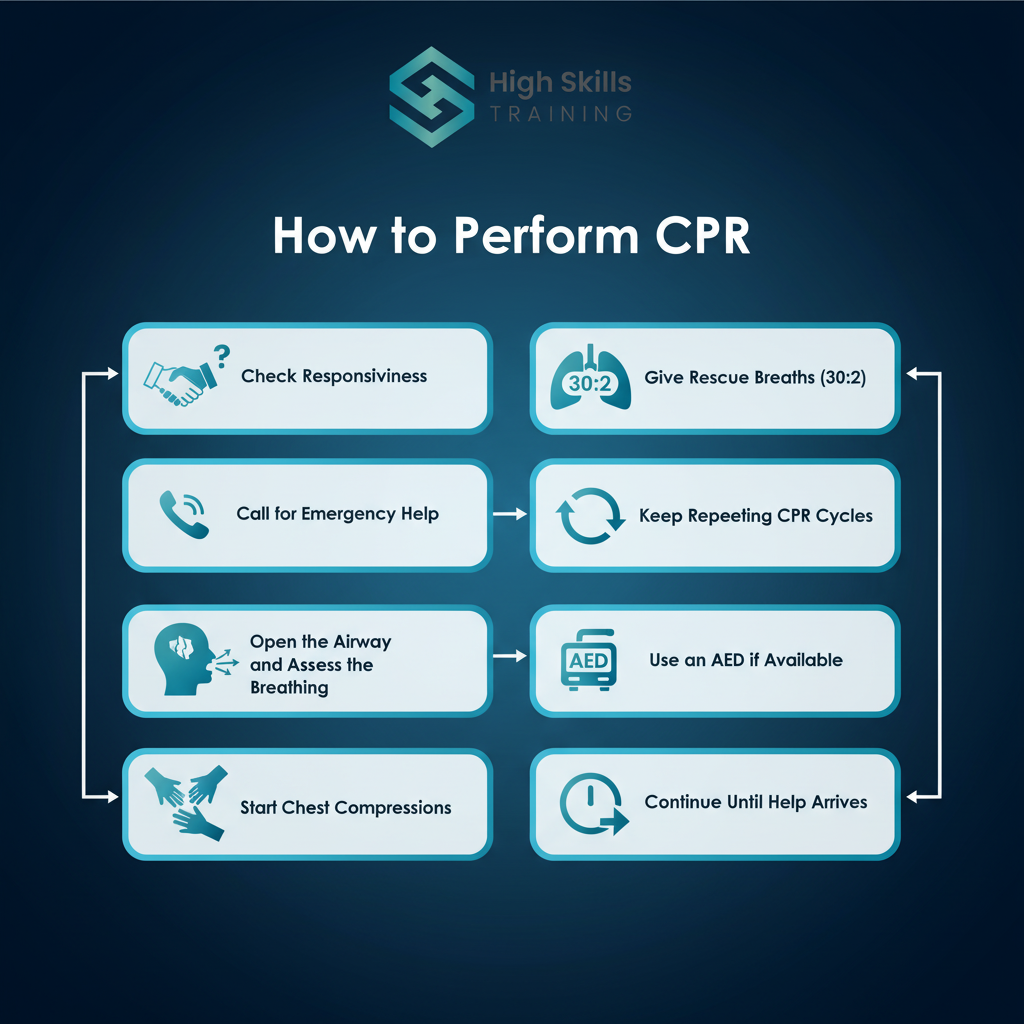
Performing CPR correctly can increase an individual’s survival rate by two to three times. Here’s a simple step-by-step guide that can help you act quickly and confidently.
1. Ensure the Scene Is Safe
Before touching the victim, loop up the area to ensure there is no danger, such as traffic, fire, electricity, or anything that may cause harm to you. You should not be a victim by yourself.
2. Check Responsiveness
You should slap the shoulder of the person and ask him: Do you feel okay?
Also, check whether there is any movement into the body, opening of the eyes, or sound.
3. Call for Emergency Help
If you fail to do so, you should call the emergency services.
You can take help from people around you; point to someone and say, “You, call emergency services now!”Early assistance will increase the rate of survival.
4. Open the Airway and Assess the Breathing
Tilt the head back, raise the chin, and see whether there is breathing, not for more than 10 seconds.
In case there is no regular breathing, gasping, or no movement, you must begin CPR immediately.
5. Start Chest Compressions
Start chest compression based on the patient’s need, like adult, children, and infant CPR, which is given above.
6. Give Rescue Breaths (30:2)
You should give the breath to the patient’s body as needed. Based on his breathtaking ability. You should not provide too much or too little breath.
7. Keep Repeating CPR Cycles
When you provide breath, you should maintain a cycle of thirty compressions and two breaths without long pauses. You should continue at a Consistent speed until the patient’s response.
8. Use an AED if Available
Turn the AED on and follow the voice instructions. It will guide you step by step and tell you when to give a shock or continue CPR.
9. Continue Until Help Arrives
Do not stop until the body response or an apparent reason occurs.
It is a fundamental question to know when to stop CPR. Without knowing it, you can’t perform CPR properly and can’t save others’ lives. So, you should stop CPR only when:
1. The Person is Indicating the Life
When the patient starts normal breathing, movement, coughing, or opening their eyes, then you should stop compressions and place them in the recovery position.
2. It is replaced by professional assistance
When trained medical responders arrive and take control, you can step back.
3. You Are Tired of Body and Soul
In this case, if you really are unable to continue because of excessive fatigue, and one of the people can assist, you can give up.
4. The Scene Becomes Unsafe
To prevent being at risk because of fire, falling debris, threats, or any other danger, cease CPR and go to safety.
5. An AED Tells You to Stop
If the AED commands you to cease compressions during a shock delivery.

Only for £59 (was £999)
Access 400+ expert-led courses for 12 months.No hidden fees. Cancel anytime.
Get Access NowCPR may be the only thing that can save a life in a life-threatening situation, but simple errors may have a significant impact. Understanding the most frequent CPR faults and the ways to avoid them, you will be able to follow every CPR step correctly and provide a person with the best chance to survive.
Error: A lot of lifesavers are afraid of cracking the ribs, and thus, they press too tightly.
Should do: Push hard and deep at least 2 inches (5 cm) in adults. Hard compressions can save a life.
Error: The incorrect position of the hands can cause too high or too low pressure on the chest.
Should do: Put your hands at the mid chest, between nipples.
Error: Too slow compressions or too fast compressions on the chest may cause harm to the body.
Should do: Keep the compressions to 100 -120 a minute.
Error: If you are bending at the chest and failing to lift it back, it also leads to harm.
Should do: The heart needs to be empty of pressure after every push so that the heart can refill with blood. You should give a bump break.
Error: Spent too much time examining breathing or pulse.
Should do: Do not take longer than 10 seconds. If you’re unsure, you should start CPR.
Error: Over-blowing and pushing air into the stomach and not the lungs.
Avoid: You should provide slow, calm breaths. Watch the chest rise softly.
Error: A person stops doing CPR when he/she is exhausted or scared.
Should do: Keep doing CPR until someone arrives, until the person breathes, or the AED tells you to stop.
CPR is often misunderstood, and there are several myths that prevent people from doing CPR. The misconceptions about the capability of a person to give CPR may cause fear and reluctance. Such misunderstandings can be cleared to make you take action when a life is at stake.
Myth 1: I will cause pain to the individual by administering CPR
Reality: Nothing is more destructive than doing CPR. Fractured ribs are not dangerous and are very common compared to cardiac arrest
Myth 2: CPR should be performed only by those who have professional training.
Reality: Anybody can do Hands-Only CPR. The things you do can either save the life of the victim twice or even thrice.
Myth 3: When the individual is gasping, then I should not do CPR.
Reality: It is gasping breathing, which is a cardiac arrest manifestation. You should start CPR immediately.
Myth 4: CPR always saves lives.
Reality: CPR is not a sure thing, but it can maintain the oxygen flow and give the individual a chance of life-saving until medical aid comes.
The main goal of CPR is to keep the flow of blood and oxygen to the brain and vital organs until help arrives, prevent brain damage, and increase chances of survival.
The recovery position is to put an unconscious but breathing person on their side with their head back so the airway is open and vomit can’t get in the throat.
CPR can cause minor harm like broken ribs or soreness, but that’s small compared to saving a life. CPR is always worth it in an emergency.
The AEDs are applied to check the heartbeat of a person during a sudden cardiac arrest and whether a shock would be required. It administers a regulated electric shock and premature defibrillation to rectify life-threatening rhythms like ventricular fibrillation.
CPR is a very easy and powerful technique that can save many lives in just a few seconds. When you understand how to act during a crisis, you can stay calm, focused, and ready to help others.
Knowing how and when to administer CPR, and when should you stop CPR, makes you a better, more assured, and peer rescuer. The steps are used to safeguard the brain, support organs, and greatly enhance survival rates.
Ultimately, knowing CPR is not just a skill; it is also an obligation to save the people you love around you. You can be a lifesaver with the practical knowledge you gain.

High Skills Training is a UK-based CPD training provider offering structured online courses and educational resources across health and social care, business administration, and professional development, supporting recognised standards and ongoing workforce development.
Get the latest insights, tutorials, and deep dives delivered to your inbox every week.
🔒 No spam. Unsubscribe anytime.
Learn how to get pet first aid certified in the UK. Find accredited courses, understand certification types, and discover why it matters for pet...
View This Blog
Explore what is the purpose of basic life support and understand how CPR, compressions, and AED use help save lives in emergencies. Read this...
View This Blog
How to get a first aid certificate? Choose a training provider, select your course, complete the course and then get your first aid certificate.
View This Blog
